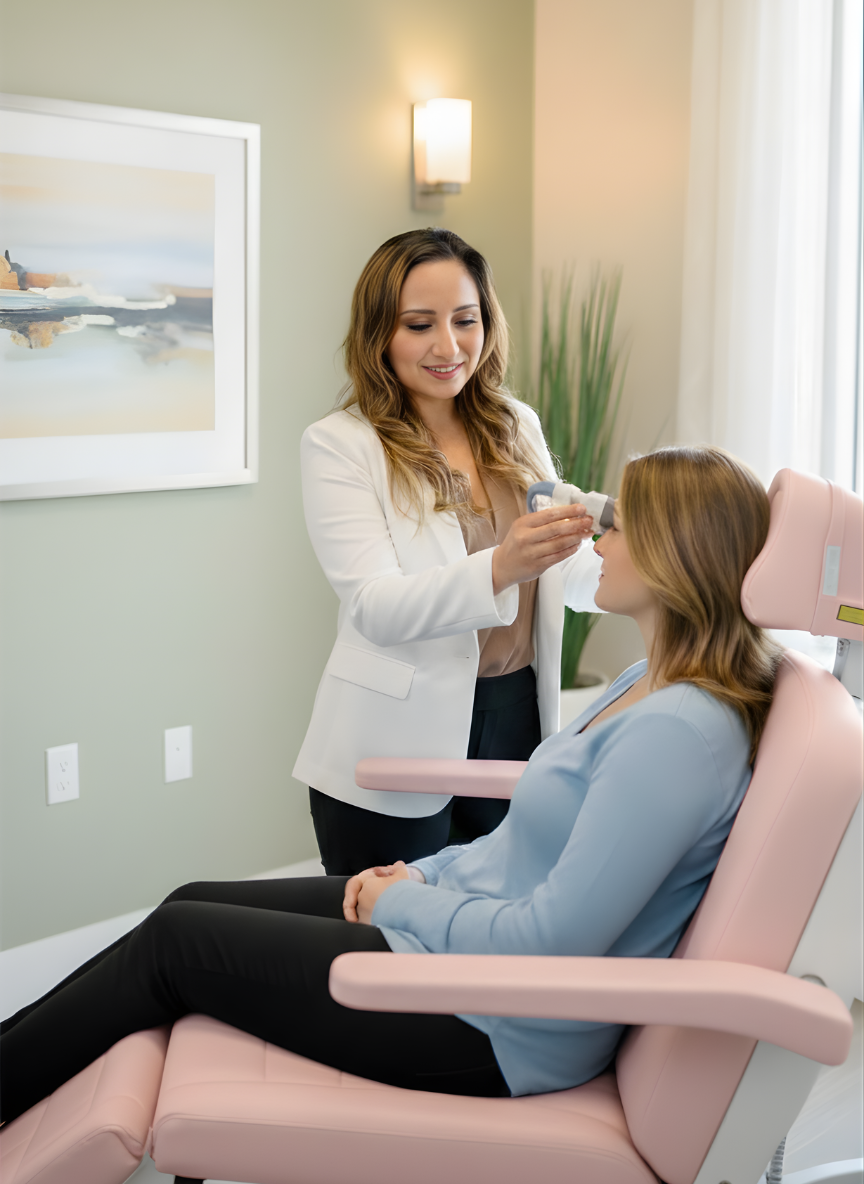
TMS side effects are one of the first things people ask about, and that makes sense. You are being asked to sit in a chair while a coil taps magnetic pulses against your head, five days a week. It is natural to wonder what that will feel like and whether it will get in the way of work, family or driving home.
This article focuses on the lived experience: what people commonly notice in the first few sessions, how that tends to change over a course, what is genuinely rare, and the practical adjustments clinicians make. For the formal safety overview, including who should not have TMS, see our TMS side effects and safety page.
The most common TMS side effects
According to the National Institute of Mental Health, the most common side effects of repetitive TMS are generally mild. They include:
- Headache
- Scalp discomfort at the site of stimulation
- Tingling, spasms or twitching of the facial muscles
- Lightheadedness
TMS does not require anesthesia, and you remain awake and alert throughout. That is one of the clearest differences from electroconvulsive therapy (ECT). You can drive yourself home and go back to your day.
Each pulse also makes a loud clicking sound, which is why hearing protection is worn during every session.
What the first session usually feels like
The first visit is longer than the rest because your psychiatrist maps the right spot and strength for you. To do that, the clinician finds your motor threshold, the lowest strength that makes your thumb or fingers twitch slightly. Many people find this part interesting rather than uncomfortable. Treatment settings are then based on that measurement.
When treatment pulses begin, most people describe a tapping or knocking sensation on the scalp, sometimes compared to a woodpecker. Some feel the muscles around the eye, jaw or forehead twitch with the pulses. It can be surprising the first time, and it is normal to feel uneasy.
If you want a step-by-step look at the visit itself, our what to expect from TMS page covers check-in, positioning and timing. If you are ready to talk through your own risk factors, the TMS side effects and safety page explains how Healing Mindz screens and monitors patients before and during a course.
Session by session: how the experience tends to change
Every patient is different, but many describe a similar arc.
| Point in the course | What patients commonly report | What the care team often does |
|---|---|---|
| Mapping visit | Thumb or finger twitch during motor threshold testing; curiosity or nerves | Explains each step, sets the target and strength |
| Sessions 1 to 3 | Tapping on the scalp, facial twitching, a mild headache afterward for some | May start a little below the target strength and increase gradually |
| End of week 1 | Scalp sensitivity often begins to ease as people get used to it | Checks in at each visit, fine-tunes coil position if needed |
| Weeks 2 to 3 | Sessions feel routine; headaches, if any, are usually less frequent | Reviews any medication or sleep changes |
| Weeks 4 to 6 | Most people describe sessions as uneventful | Tracks mood with rating scales and plans next steps |
This is a general pattern rather than a guarantee. Some people barely notice anything from day one, and a smaller number find the sensation harder to get used to.
What is rare
The most serious risk associated with TMS is a seizure. NIMH describes seizures as a rare side effect. The risk is one reason TMS is given in a medical setting, under physician supervision, with careful screening before treatment starts.
Things that may raise seizure risk, and that your psychiatrist will ask about, include:
- A personal history of seizures or epilepsy
- Certain medications, or recent changes in medication
- Heavy alcohol use or recent alcohol withdrawal
- Significant sleep deprivation
Other uncommon concerns people ask about:
- Hearing. The clicking is loud, so earplugs or similar protection are worn every session.
- Memory. TMS does not use anesthesia or induce a seizure, and it is not generally associated with the memory problems that can follow ECT.
- Metal in or near the head. Non-removable metal objects close to the coil, such as certain implants, can make TMS unsafe. This is part of the screening.
How clinicians adjust treatment to keep it comfortable
If something bothers you, say so. Most discomfort can be addressed without stopping treatment. Common adjustments include:
- Ramping up gradually. Starting slightly below target strength and building over the first sessions lets the scalp adapt.
- Repositioning the coil. Small shifts can reduce facial or jaw twitching while keeping the target.
- Simple pain relief. Your clinician may suggest an over-the-counter pain reliever before or after sessions if that is safe for you.
- Comfort measures. Hearing protection is checked, and some patients find it easier to talk, listen to something calm or practice slow breathing during the session.
- Reviewing medications. If you start or stop a medication, including over-the-counter ones, tell the team before your next session.
You stay in control. You can ask the technician to pause at any time. Speaking up early, rather than gritting your teeth through a whole week, gives your care team the information they need to make sessions more comfortable without compromising treatment.
Practical tips for your first week
Small preparations can make the early sessions easier:
- Eat and hydrate normally. There is no need to fast, and a regular meal can help if you are prone to lightheadedness.
- Remove metal from your head and neck area. Hair clips, earrings and some hair accessories should come off before you sit down.
- Bring a list of your medications and tell the team about anything new, including over-the-counter sleep aids or supplements.
- Keep a short note of any headache or discomfort after each session, including how long it lasted. This helps your clinician decide whether to adjust anything.
- Protect your sleep. Going into sessions well rested supports both comfort and safety.
None of this is complicated, but it gives you a sense of control during a week that can feel unfamiliar.
Feeling emotionally stirred up
Some people notice that their mood shifts during a course, sometimes in a bumpy way, before it settles. Any worsening of mood, new agitation or thoughts of self-harm should be reported right away. Your psychiatrist follows your progress with standardized rating scales and conversation, not just the machine settings. If you are in crisis, call or text 988, the Suicide and Crisis Lifeline.
Getting to and from sessions
Because there is no anesthesia, you can drive yourself to and from treatment. TMS at Healing Mindz is delivered at the New City office in Rockland County, which has free on-site parking. Patients coming from Orange County can start with a consultation at the Middletown office. Our TMS in Rockland County page has more on scheduling around work and school.
Side effects are worth taking seriously, and so is the burden of depression that has not responded to other treatment. A good TMS team will help you weigh both and will keep checking in every step of the way.