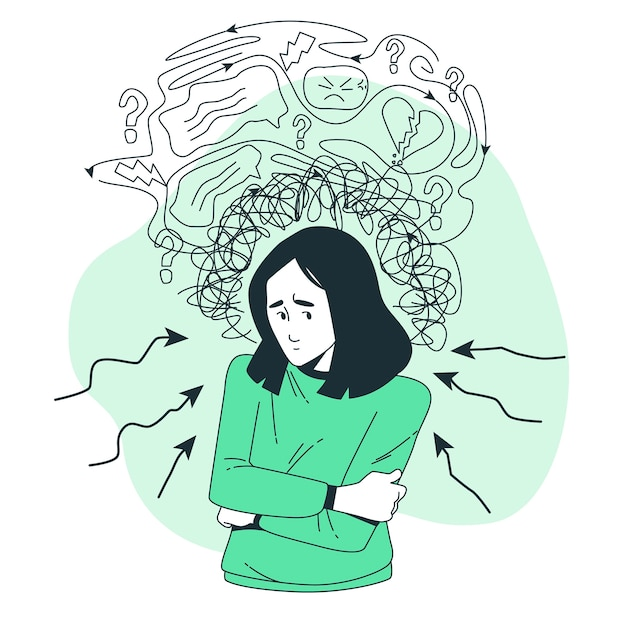
If you have typed "TMS for anxiety near me" into a search bar, you are probably living with both a heavy, low mood and a mind that will not stop worrying, and you want to know whether one treatment could help with both. The answer depends on your diagnosis. TMS is FDA-cleared to reduce anxiety symptoms in adults who have major depressive disorder, a pattern often called anxious depression. It is not FDA-cleared for anxiety disorders on their own. This article explains that distinction, why it matters, and how to figure out where you fit.
Anxiety and Depression So Often Arrive Together
Depression and anxiety are separate conditions, but they frequently occur at the same time. The National Institute of Mental Health notes that people with anxiety disorders often also experience depression, and the American Psychiatric Association describes anxiety, restlessness and irritability among the ways depression can show up. Many people describe it as being exhausted and on edge at once: no energy to start anything, yet unable to relax.
This combination matters clinically. When depression comes with prominent anxiety, it can feel more distressing and can be harder to treat. That is part of why a treatment that addresses both sets of symptoms drew attention.
What the FDA Cleared for TMS and Anxiety
To see how we apply this in practice, our page on TMS for anxious depression explains who we evaluate for it and how treatment is planned.
In 2021, the U.S. Food and Drug Administration cleared one deep TMS system to reduce anxiety symptoms in adult patients with major depressive disorder, sometimes described as comorbid anxiety symptoms. The clearance applies to people whose primary diagnosis is depression and who also have significant anxiety. It builds on the original FDA clearance of TMS for major depressive disorder in 2008.
What the clearance does not say is just as important. It does not cover generalized anxiety disorder, panic disorder or social anxiety disorder as stand-alone diagnoses. Research into TMS for those conditions exists, but they are not FDA-cleared indications, so any use would be off-label and should be discussed openly with a physician.
TMS for Anxiety Near Me: Where You Fit
The table below shows how FDA status lines up with common situations. Your diagnosis is the deciding factor, which is why an evaluation comes first.
| Your situation | FDA status for TMS | What it means for you |
|---|---|---|
| Major depressive disorder | Cleared since 2008 | TMS may be considered, often after medications have not helped enough. |
| Major depression with significant anxiety symptoms | Cleared in 2021 for one deep TMS system to reduce anxiety symptoms in adults with MDD | This is the "anxious depression" indication. |
| Generalized anxiety disorder without depression | Not FDA-cleared | Standard treatments such as therapy and medication come first; TMS would be off-label. |
| Panic disorder or social anxiety without depression | Not FDA-cleared | Same as above; discuss evidence-based first-line care. |
| Obsessive-compulsive disorder | Deep TMS cleared in 2018 | A separate indication with its own protocol. |
| PTSD | Not FDA-cleared; emerging research | Any use would be off-label after careful discussion. |
Why TMS May Help Anxiety Symptoms in Depression
TMS delivers magnetic pulses to brain regions involved in mood regulation. The National Institute of Mental Health describes brain stimulation therapies as acting on networks of brain activity rather than on a single chemical. When depression improves, related symptoms such as sleep disruption, poor concentration and persistent worry often shift as well. The 2021 clearance reflects data showing a reduction in anxiety symptoms among adults being treated for depression.
That does not mean every patient's anxiety will improve, or improve to the same degree. Responses vary, and your physician will track both depression and anxiety symptoms with rating scales throughout the course so that progress is measured rather than guessed.
It is also worth knowing that TMS is usually one part of a larger plan rather than a replacement for everything else. Many patients continue their medications during a course, and therapy can continue alongside it. Skills learned in therapy, such as noticing anxious thought patterns or gradually facing avoided situations, can complement the changes some people feel as their mood lifts. Your physician will help you decide how the pieces fit together.
What If Anxiety Is Your Main Problem?
If anxiety is front and center and depression is mild or absent, TMS is generally not where treatment starts. Effective, evidence-based options for anxiety disorders include psychotherapy, particularly cognitive behavioral therapy, and medication. The National Institute of Mental Health lists both as standard approaches. Our anxiety treatment page describes how we approach anxiety disorders, and medication management can help when medication is part of the plan.
It is also common for people to believe their main issue is anxiety and then discover, through a careful evaluation, that an underlying depression has been driving much of it. That is one reason a full psychiatric evaluation is so valuable before deciding on any treatment.
Getting Evaluated Near You
For patients in Rockland County, all TMS treatment at Healing Mindz takes place at our New City office on Congers Road. If you live in Orange County, you can start with a consultation at our Middletown office or by telehealth and then travel to New City for sessions. A typical course runs about 30 to 36 sessions, five days a week, over four to six weeks.
Your evaluation will cover your mood history, the pattern and severity of your anxiety, medications you have tried, and safety screening for TMS. If anxious depression is the right description, your physician will explain the treatment plan, the device and protocol you would be treated with, and what to expect. If it is not, you will leave with a clearer diagnosis and a plan that fits it. You can also learn more about our broader depression treatment options.
What a TMS Week Looks Like
Practically, TMS for anxious depression follows a similar rhythm to other TMS courses. You come in about five days a week, sit in a comfortable chair while the coil delivers pulses, and leave when the session ends. There is no sedation, so you can drive yourself home and go back to work or the rest of your day. The Mayo Clinic lists headache, scalp discomfort and facial tingling among the more common side effects, and notes that these usually ease over time.
For people with significant anxiety, the first session can feel like a big step. It is completely reasonable to ask the team to explain each part of the process before it happens, to start with a short tour of the treatment room, or to bring questions written down. Many patients find that the predictability of the routine, the same room, the same time, the same staff, becomes reassuring as the weeks go on. Your physician will check in regularly and adjust the plan if something is not working for you.
A Note on Safety
If anxiety or depression ever leads to thoughts of harming yourself, call or text 988 to reach the 988 Suicide and Crisis Lifeline, or call 911. Those feelings are a reason to get help now, not after a treatment decision is made.
The short version: if your depression comes with heavy anxiety, TMS may be worth discussing. If anxiety stands alone, other treatments come first. Either way, the first step is an evaluation with a psychiatrist who can tell the difference. Call (845) 480-6678 to schedule.