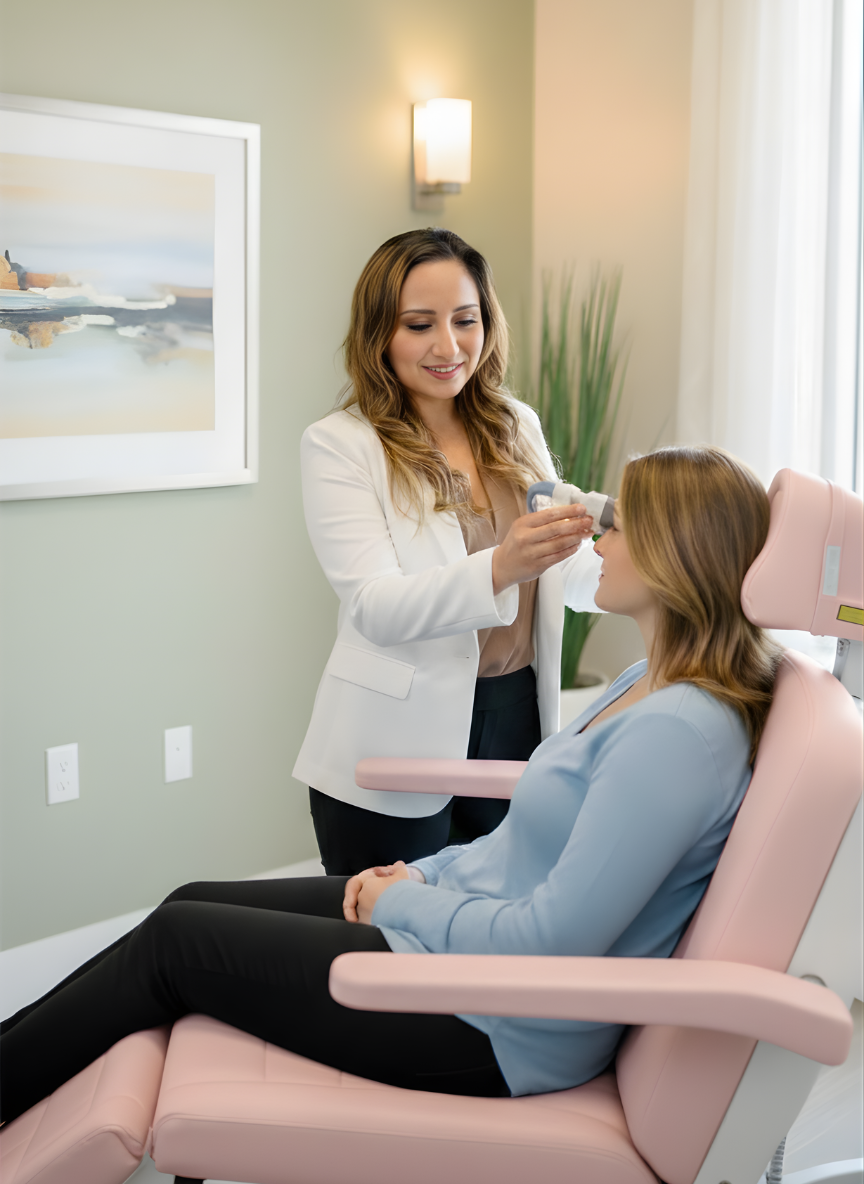
Deep TMS vs rTMS is a comparison many patients run into while researching treatment, and it is genuinely confusing, partly because the terms overlap. Both are forms of repetitive transcranial magnetic stimulation. The main difference is the shape of the magnetic coil, which affects how focused the stimulation is and how far it reaches. Devices are also FDA-cleared for different conditions. This article explains the differences in plain language so you can ask better questions about your own care.
One note up front: this article does not tell you which device Healing Mindz uses. That is deliberate. The right answer depends on your diagnosis and treatment plan, so please ask us which device and protocol you will be treated with during your evaluation.
The Basics: What Every TMS Device Does
All TMS devices use a coil, placed against the scalp, that generates brief magnetic pulses. The National Institute of Mental Health explains that these pulses induce small electrical currents in the brain region beneath the coil, influencing activity in circuits involved in mood. When pulses are delivered in repeated trains, the treatment is called repetitive TMS, or rTMS. All the treatments discussed here are noninvasive, do not require anesthesia, and are done while you are awake.
So when people say "rTMS" in contrast to "deep TMS," they usually mean rTMS delivered with a traditional figure-8 coil. Deep TMS is also repetitive; it simply uses a different coil design.
Figure-8 Coils and Deep TMS (H-Coils)
For an overview of how TMS fits into care at our practice, including who is a candidate and what a course involves, visit our TMS therapy page.
A figure-8 coil has two round windings side by side, like the number 8. The magnetic field is strongest where the two loops meet, which creates a relatively focused area of stimulation near the surface of the brain. The first TMS device cleared by the U.S. Food and Drug Administration for major depressive disorder, in 2008, used a figure-8 style coil.
Deep TMS uses a differently shaped coil, often called an H-coil, built into a helmet-like cap. It is designed to stimulate a broader area and to reach somewhat deeper below the surface than a figure-8 coil. That broader reach comes with less focal precision. Deep TMS was cleared by the FDA for major depressive disorder in 2013, and in 2018 the FDA permitted marketing of a deep TMS device for obsessive-compulsive disorder.
Deep TMS vs rTMS: Side-by-Side Comparison
The table summarizes the key differences. FDA clearances are given to specific devices for specific uses, so the FDA column refers to what has been cleared for at least one device of that type, not every device.
| Feature | Figure-8 coil rTMS | Deep TMS (H-coil) |
|---|---|---|
| Coil design | Two circular windings forming an 8 | Larger, helmet-style coil array |
| Stimulation pattern | More focused, closer to the surface | Broader, reaching somewhat deeper |
| First FDA clearance for depression | 2008 | 2013 |
| Other FDA-cleared uses (device-specific) | Adolescents 15 to 21 with depression as an add-on treatment (2024, one device) | OCD (2018), smoking cessation (2020), anxiety symptoms in adults with depression (2021) |
| Theta burst protocols | Intermittent theta burst cleared for depression in 2018 on figure-8 systems | Protocols are device-specific; ask your provider |
| Typical session length | About 20 to 40 minutes for standard protocols; theta burst sessions are much shorter | Commonly around 20 minutes, depending on the indication |
| Common side effects | Headache, scalp discomfort, facial twitching | Similar, with headache and scalp discomfort most common |
Both coil types are used with the same general preparation. At the first session, the team measures how strongly you need to be stimulated, often by finding the lowest intensity that produces a small movement in your hand, and determines where on your head the coil should sit. That information guides every session that follows, regardless of the device.
Where Theta Burst Fits In
Theta burst stimulation is a pattern of delivering pulses, not a type of coil. Instead of steady trains of pulses, it uses rapid bursts that are repeated in a rhythm. In 2018 the FDA cleared intermittent theta burst stimulation (iTBS) for depression on figure-8 coil systems. The main practical appeal is time: the active stimulation in a theta burst session takes only a few minutes, compared with roughly 20 to 40 minutes for many standard protocols.
Shorter sessions can make a five-day-a-week course easier to fit around work and family. Whether theta burst is appropriate for you depends on your diagnosis, history and your physician's judgment.
Is One Better Than the Other?
This is the question everyone wants answered, and the honest answer is that there is no simple winner. Each coil type has been studied and cleared for depression. Large head-to-head trials directly comparing the two are limited, and response varies from person to person regardless of device. For some indications, such as OCD or anxiety symptoms in depression, FDA clearance currently exists only for specific deep TMS devices, which can matter for both treatment planning and insurance coverage.
In practice, what tends to matter most is that the device is FDA-cleared for your condition, that the protocol is appropriate for you, that targeting and dosing are done carefully, and that a physician is supervising your care.
Questions to Ask Any Provider
When you meet with a TMS team, it is reasonable to ask: Which device will I be treated with? What is it FDA-cleared for, and does that include my diagnosis? Which protocol will you use, and how long will each session be? How will you decide where to place the coil and how strong the pulses should be? How will we measure whether it is working?
At Healing Mindz, please ask us which device and protocol you will be treated with. Our TMS program is psychiatrist-supervised, the same physician follows you throughout, and all treatment takes place at our New City office in Rockland County. If you are exploring TMS for a particular condition, our pages on TMS for OCD, TMS for anxious depression and treatment-resistant depression go into more detail, and our TMS side effects and safety page covers what to expect physically.
How Insurance Fits Into Device Choice
Insurance plans typically cover TMS for specific diagnoses, and their policies may reference FDA-cleared indications. That means the device and its cleared uses can affect whether a course is approved, particularly for conditions other than depression. Before you start, your provider should be able to explain how the device they plan to use relates to your diagnosis and to your plan's requirements. Our TMS cost and insurance page explains how we verify benefits and handle prior authorization.
The Takeaway
Figure-8 rTMS and deep TMS are two coil designs for the same basic idea: using magnetic pulses to influence mood-related brain circuits. Figure-8 coils are more focused; deep TMS coils reach a broader, somewhat deeper area. Each has its own set of FDA-cleared uses, and theta burst is a faster stimulation pattern rather than a separate device. The best choice is the one that fits your diagnosis and is delivered carefully. To talk it through with a psychiatrist, call (845) 480-6678.