"I'm so OCD about my closet." "She's totally OCD about her desk." You have probably heard — or even said — phrases like this more times than you can count. Somewhere along the way, Obsessive-Compulsive Disorder became cultural shorthand for being tidy, organized, or particular about how things look.
The reality is dramatically different, and for the millions of people actually living with OCD, that casual misuse of the term is not just inaccurate — it is genuinely painful. OCD is not a personality quirk. It is not a preference for neatness. It is a serious, often debilitating psychiatric condition built on intrusive, terrifying thoughts and the exhausting compulsions used to silence them. Many people with OCD spend hours every single day trapped in mental rituals that have nothing to do with cleanliness at all — checking, counting, repeating, seeking reassurance, mentally reviewing — desperately trying to neutralize fears that feel, in the moment, completely real and completely unbearable.
At Healing Mindz, Dr. Singh, a Board-Certified Psychiatrist serving Middletown, New City, Rockland County, and across the Hudson Valley, provides comprehensive, evidence-based care for OCD — including specialized therapy and FDA-cleared TMS treatment for patients whose symptoms have not responded to conventional approaches.
This guide will help you understand what OCD actually is, why it is so often missed or misunderstood, and what real treatment looks like.
What OCD Actually Is — Beyond the Stereotypes
Obsessive-Compulsive Disorder is a chronic psychiatric condition built around two interlocking components:
Obsessions are intrusive, unwanted, distressing thoughts, images, or urges that repeatedly enter a person's mind, despite their best efforts to ignore or suppress them. Critically, these thoughts are experienced as deeply unwanted and inconsistent with who the person actually is or wants to be — which is precisely why they cause such profound distress.
Compulsions are repetitive behaviors or mental acts that a person feels driven to perform in response to an obsession, in an attempt to reduce the anxiety it causes or to prevent some feared outcome. Compulsions are rarely connected to the feared outcome in any realistic way, and even when they are, they are performed far more often or for far longer than necessary.
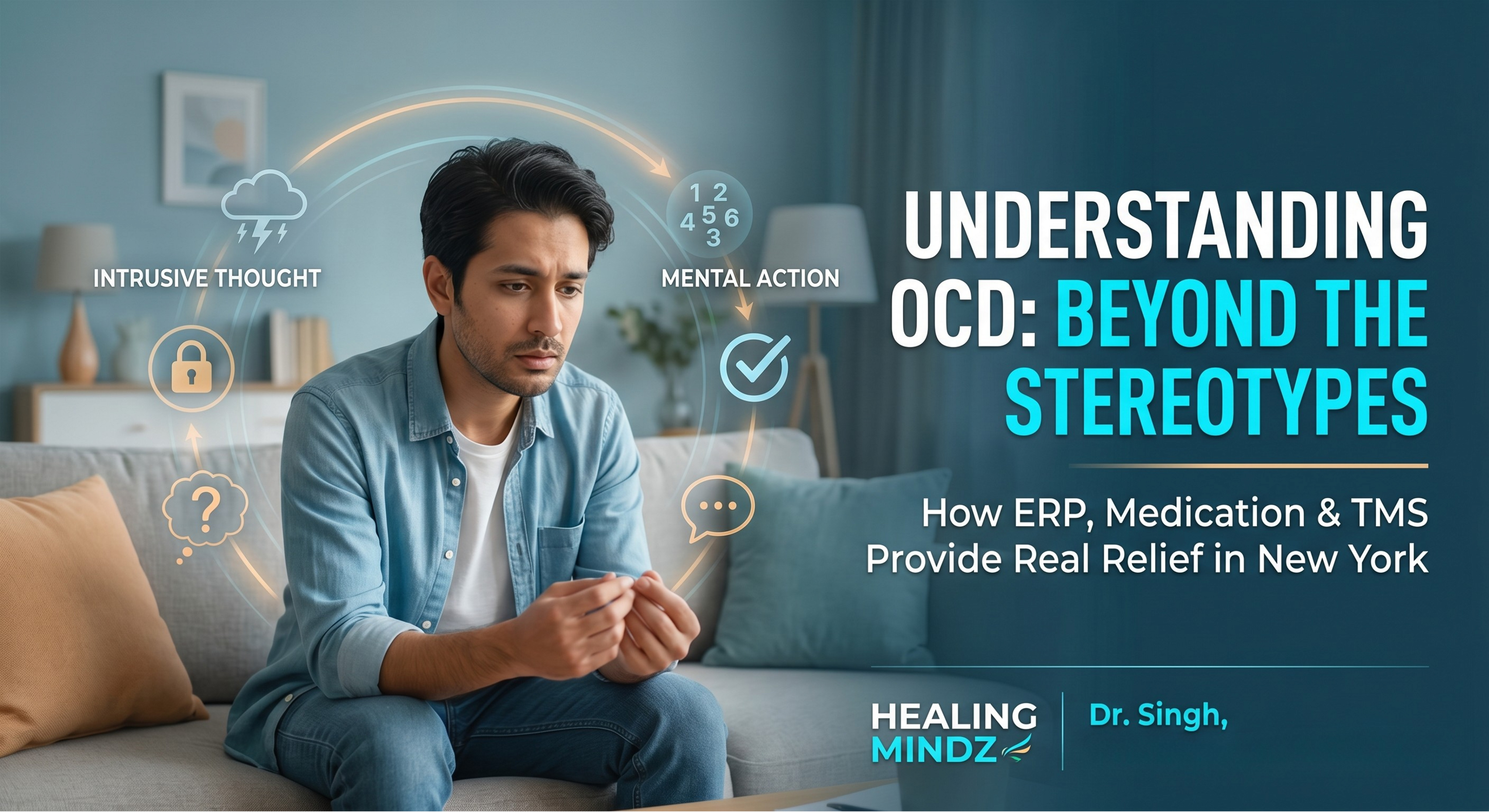
The cycle is exhausting and self-reinforcing: an intrusive thought triggers intense anxiety, a compulsion is performed to relieve that anxiety, the relief is temporary, and the obsession returns — often stronger, and requiring a more elaborate compulsion the next time. Over months and years, this cycle can consume hours of a person's day and profoundly limit their ability to work, maintain relationships, and function.
The OCD Subtypes Nobody Talks About
Contamination fears and excessive handwashing are the OCD presentation most people are familiar with — largely because it is the version most often depicted in media. But this is only one of many distinct OCD subtypes, and many of the most common forms of OCD have nothing to do with cleanliness or order at all.
Contamination OCD involves intense fear of germs, illness, or contamination, leading to excessive washing, cleaning, or avoidance of perceived contaminants.
Checking OCD involves persistent doubt about whether something was done correctly — did I lock the door, did I turn off the stove, did I hit someone with my car — leading to repeated checking behaviors that can consume enormous amounts of time.
Symmetry and Order OCD involves distress when things are not arranged "just right," accompanied by a felt sense — rather than a logical reason — that something terrible will happen if symmetry or order is not achieved. This is the subtype most commonly (and inaccurately) conflated with simply liking things neat.
Intrusive Thoughts OCD (often called "Pure O") involves disturbing, unwanted thoughts — frequently violent, sexual, or blasphemous in nature — that cause the person profound shame and distress precisely because the thoughts are so contrary to their actual values and character. Compulsions in this subtype are often mental rather than physical: mental reviewing, silent prayers, counting, or seeking reassurance.
Relationship OCD (ROCD) involves obsessive doubt about one's feelings toward a partner, or a partner's feelings toward them, leading to constant mental analysis, reassurance-seeking, and comparison.
Harm OCD involves intrusive fears of causing harm to others — including loved ones — despite having no actual desire or intention to cause harm. This subtype is often accompanied by intense shame, since patients fear that having the thought means something is fundamentally wrong with them.
Health Anxiety OCD involves persistent, intrusive fears of having a serious illness, often accompanied by repeated body checking, medical reassurance-seeking, or excessive research into symptoms.
If you recognize yourself in any of these descriptions, please understand: having intrusive thoughts does not mean you want to act on them, and it does not reflect your true character or desires. This is one of the most important and most frequently misunderstood truths about OCD — and it is precisely why an accurate psychiatric evaluation, rather than self-diagnosis or internet research, matters so much.
Why OCD Is So Frequently Misdiagnosed or Missed Entirely
Research consistently shows that the average person with OCD waits years before receiving an accurate diagnosis — and many never receive one at all. Several factors drive this gap:
Shame and secrecy. Many of the most common OCD obsessions — particularly intrusive thoughts involving harm, sexuality, or blasphemy — are so distressing and so contrary to a person's values that they are terrified to disclose them to anyone, including a doctor. Patients often suffer in silence for years rather than risk being seen as dangerous or disturbed.
Misattribution to anxiety or depression. Because OCD frequently co-occurs with generalized anxiety and depression, and because the exhausting, draining nature of the condition produces depressive symptoms, many patients are diagnosed and treated for anxiety or depression alone — while the underlying obsessive-compulsive cycle driving those symptoms goes completely unaddressed.
The cultural stereotype itself. When the dominant cultural image of OCD is "liking things clean," patients whose OCD does not involve visible cleaning rituals — particularly those with Pure O, Harm OCD, or ROCD — often do not recognize their own experience as OCD at all, and therefore never seek a relevant evaluation.
Compulsions that look "normal." Mental compulsions — silent reviewing, counting, praying, reassurance-seeking — are invisible to outside observers and often even to the person performing them, making this presentation of OCD especially likely to be missed in a brief clinical encounter.
How OCD Is Properly Diagnosed at Healing Mindz
At Healing Mindz, Dr. Singh conducts a comprehensive psychiatric evaluation specifically designed to identify OCD accurately — including its less obvious presentations — rather than relying on surface-level symptom checklists.
This evaluation includes:
A detailed exploration of obsessions and compulsions — Dr. Singh creates a safe, nonjudgmental space for you to describe your specific intrusive thoughts and the behaviors or mental rituals you use to manage them, without fear of shame or misunderstanding.
Assessment of functional impact — Understanding how many hours per day your symptoms consume, and how they are affecting your work, relationships, and quality of life, is essential to accurate diagnosis and treatment planning.
Differential diagnosis — OCD must be carefully distinguished from generalized anxiety disorder, body dysmorphic disorder, generalized worry, and in some cases, psychotic disorders. This distinction directly shapes the most effective treatment approach.
Use of validated clinical assessment tools — Standardized OCD severity scales provide objective measurement that supports diagnosis and allows Dr. Singh to track your progress throughout treatment.
Identification of co-occurring conditions — Depression, generalized anxiety, and ADHD frequently accompany OCD and must be addressed as part of a comprehensive treatment plan.
Receiving an accurate OCD diagnosis is often, in itself, a profound moment of relief for patients who have spent years believing that their intrusive thoughts meant something was deeply wrong with their character — when in fact, they have a well-understood, highly treatable medical condition.
Evidence-Based Treatment for OCD at Healing Mindz
Exposure and Response Prevention (ERP): The Gold-Standard Therapy for OCD
Exposure and Response Prevention is a specialized form of Cognitive Behavioral Therapy and is considered the single most effective psychotherapy for OCD, with decades of clinical research supporting its efficacy.
ERP works by gradually and systematically exposing patients to the thoughts, images, situations, or objects that trigger their obsessions — while deliberately refraining from performing the compulsion that would normally follow. Over repeated practice, this process teaches the brain that the feared outcome does not occur, and that the anxiety triggered by the obsession will naturally decrease on its own, without the compulsion.
This work is done gradually, collaboratively, and at a pace that respects each patient's readiness — never by overwhelming a patient with exposures they are not prepared for. At Healing Mindz, ERP is tailored specifically to your individual obsessions and compulsions, whether they involve contamination, checking, symmetry, intrusive thoughts, or relationship-focused doubt.
Medication Management for OCD
Certain SSRIs, often prescribed at higher doses than are typically used for depression, have demonstrated strong clinical efficacy specifically for OCD. Dr. Singh's approach to OCD medication management includes:
Precision medication selection based on your specific OCD presentation, co-occurring conditions, and treatment history.
Appropriate dosing strategies, since OCD frequently requires higher SSRI doses than depression or generalized anxiety to achieve full therapeutic benefit.
Ongoing monitoring to track symptom response, manage side effects, and make adjustments as needed throughout your treatment.
Integration with ERP therapy, since research consistently shows that combining medication with ERP produces better outcomes for many patients than either treatment alone.
Transcranial Magnetic Stimulation (TMS) for OCD
For patients whose OCD has not responded adequately to medication and ERP therapy — a population often referred to as having treatment-resistant OCD — Healing Mindz offers TMS, which has received specific FDA clearance for the treatment of OCD.
TMS for OCD uses targeted magnetic pulses to stimulate brain circuits involved in the obsessive-compulsive cycle, helping to reduce the intensity and frequency of both obsessions and the compulsive urges that follow them. It is non-invasive, requires no anesthesia, and involves no medication — making it a valuable option for patients who have struggled with medication side effects or who have not achieved adequate symptom relief through other treatments.
Clinical studies on deep TMS for OCD have shown that a meaningful proportion of treatment-resistant patients experience significant symptom improvement — offering real hope for those who have felt that nothing has worked.
OCD Treatment Near You — Middletown, New City & Hudson Valley, NY
Specialized OCD treatment — particularly ERP therapy delivered by clinicians who genuinely understand the condition — can be difficult to find, especially outside major metropolitan centers. Healing Mindz was built to bring this level of specialized psychiatric expertise directly to communities across Orange County and Rockland County.
Whether you are in Middletown, New City, Suffern, Spring Valley, Goshen, Monroe, Newburgh, or anywhere across the Hudson Valley, Dr. Singh offers:
- Comprehensive, judgment-free psychiatric evaluation for OCD and related conditions
- Specialized ERP therapy tailored to your specific obsessions and compulsions
- Precision medication management, including appropriate OCD-specific dosing strategies
- FDA-cleared TMS for treatment-resistant OCD
- Telehealth psychiatric appointments available statewide across New York and California
Frequently Asked Questions: OCD Diagnosis & Treatment in New York
Q: Is OCD just being a "neat freak" or liking things organized?
No. While some OCD subtypes do involve symmetry, order, or contamination concerns, true OCD is defined by intense distress, intrusive obsessions that the person finds deeply unwanted, and time-consuming compulsions that significantly impair daily functioning — not a simple personal preference for tidiness. Many people with OCD have no visible cleaning or organizing rituals at all.
Q: I have disturbing intrusive thoughts about harming someone I love. Does this mean I actually want to hurt them?
No — and this is one of the most important things to understand about OCD. Intrusive thoughts in Harm OCD are experienced as horrifying and deeply contrary to a person's actual values and desires precisely because the person has no intention or desire to act on them. The distress these thoughts cause is itself evidence against any genuine intent. A comprehensive psychiatric evaluation can help clarify this and provide appropriate, compassionate treatment.
Q: Can OCD be cured?
OCD is generally understood as a chronic condition that can be very effectively managed, with many patients achieving substantial, lasting symptom reduction through ERP therapy, medication, or a combination of both. Many patients reach a point where OCD no longer significantly interferes with their daily life and relationships.
Q: How is ERP different from regular talk therapy?
ERP is a highly structured, specialized form of therapy specifically designed for OCD, involving deliberate, gradual exposure to feared thoughts or situations while resisting compulsions. General talk therapy, which focuses on processing emotions and exploring underlying patterns, is generally not effective as a standalone treatment for OCD and can sometimes inadvertently reinforce compulsive reassurance-seeking. Working with a clinician trained specifically in ERP is essential for effective OCD treatment.
Q: Is TMS effective for OCD?
Yes. TMS has received specific FDA clearance for the treatment of OCD, and clinical research has demonstrated meaningful symptom improvement for many patients with treatment-resistant OCD who have not responded adequately to medication and ERP therapy alone. Dr. Singh can evaluate whether TMS may be an appropriate option for your specific clinical situation.
Q: Does Healing Mindz accept insurance for OCD treatment in New York?
Yes. Healing Mindz accepts most major insurance plans for psychiatric evaluations, ERP therapy, medication management, and TMS. Contact our office to verify your specific coverage before your first appointment.
You Are Not Your Thoughts — and You Deserve Real Treatment
If you have spent years silently battling intrusive thoughts, exhausting rituals, or a relentless need for certainty that never quite arrives, please understand this clearly: you are not broken, you are not dangerous, and you are not alone. OCD is one of the most treatable psychiatric conditions in existence — but only when it is accurately recognized and properly treated.
Dr. Singh and the team at Healing Mindz are here to offer the kind of compassionate, judgment-free, expert evaluation that allows patients to finally say out loud what they have been carrying in silence — and to receive a treatment plan that actually addresses the cycle driving their suffering.
Contact Healing Mindz today to schedule your comprehensive psychiatric evaluation.
Serving New City, NY & Middletown, NY | Telehealth available statewide across New York & California
Visit: www.healingmindzbydrsingh.com
Related Reading You May Find Helpful:
- What Is TMS Therapy? A Complete Guide to Transcranial Magnetic Stimulation for Treatment-Resistant Depression in New York
- Anxiety vs. Depression: How a Board-Certified Psychiatrist in New York Diagnoses and Treats Both
- ADHD in Adults: Signs You've Been Overlooked and How Psychiatric Evaluation Can Change Your Life
- CBT, Psychodynamic Therapy, or Medication? How Healing Mindz Builds Your Personalized Mental Health Treatment Plan