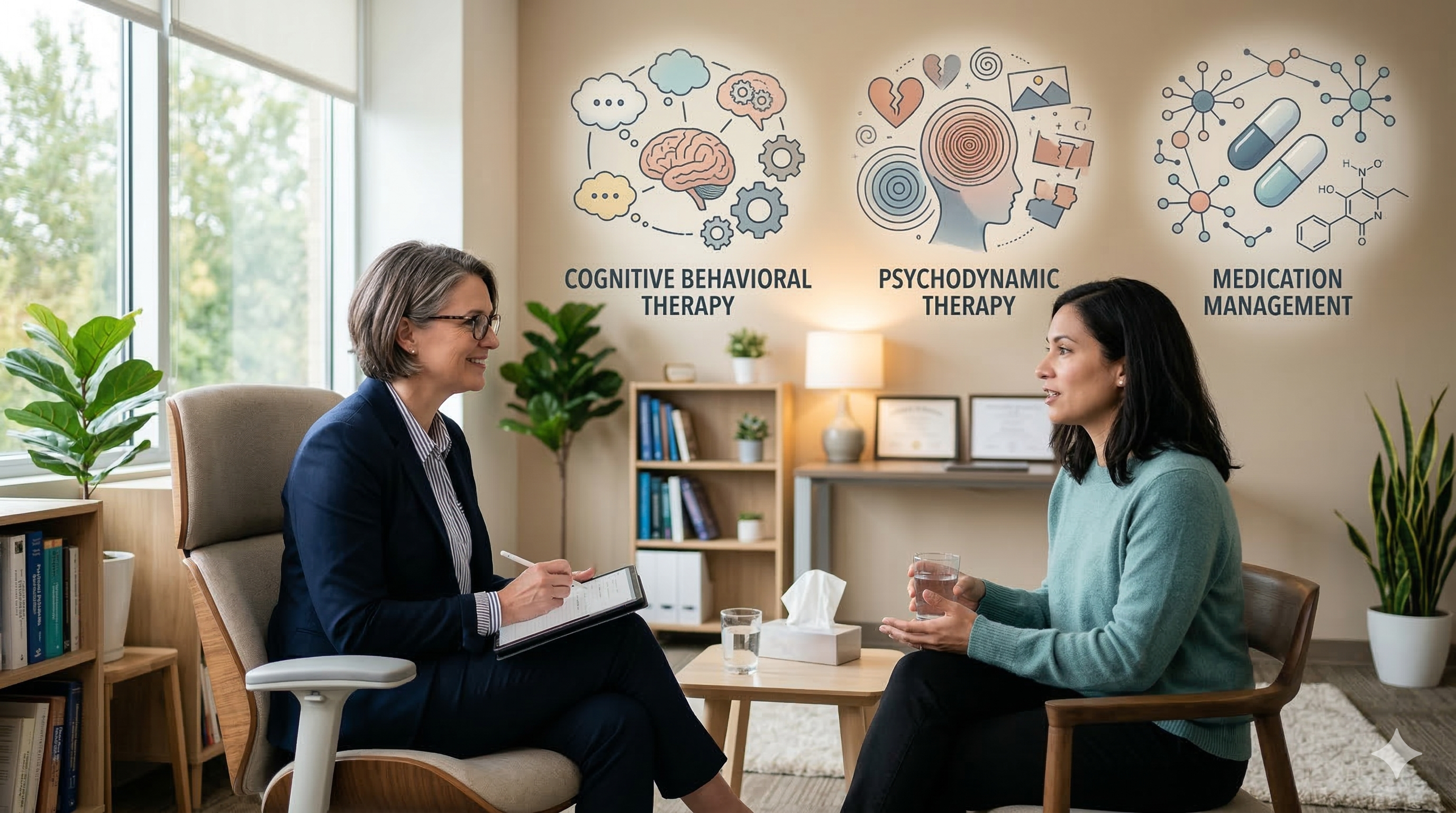
You have finally made the decision to seek help for your mental health. That took courage — and it deserves to be met with something better than a rushed 20-minute appointment, a generic prescription, and a referral to a therapist whose approach nobody bothered to explain to you.
The mental health care system can feel overwhelming, fragmented, and deeply impersonal. You search online and find yourself buried in terms you do not fully understand — CBT, psychodynamic therapy, DBT, SSRIs, SNRIs, medication management, psychiatric evaluation. You wonder: which one is right for me? Do I need therapy or medication? Are they the same thing? Do I need both? How does anyone actually figure this out?
These are not naive questions. They are exactly the right questions — and the fact that most psychiatric practices never take the time to answer them properly is one of the core reasons so many people cycle through treatments that do not work.
At Healing Mindz, Dr. Singh does things differently. Every patient who walks through our doors — whether in Middletown, New City, or anywhere across Rockland County and the Hudson Valley — receives a personalized, evidence-based mental health treatment plan built specifically around them. Not a template. Not a default protocol. A genuinely individualized plan that reflects who you are, what you are experiencing, and what your life actually looks like.
This guide will walk you through exactly how that process works — and help you understand the real differences between the major treatment approaches available to you.
Why "One-Size-Fits-All" Mental Health Treatment Fails So Many People
Before diving into the different treatment modalities, it is worth understanding why so many people with depression, anxiety, ADHD, and other psychiatric conditions spend years in treatment without getting meaningfully better.
The answer, in most cases, is not that the treatments themselves are ineffective. CBT works. Psychodynamic therapy works. Medication works. TMS works. The problem is misalignment — the wrong treatment, or the wrong combination of treatments, applied to a patient whose specific clinical profile, personal history, and individual needs were never properly understood.
Consider these scenarios, all of which are more common than they should be:
- A patient with depression rooted in childhood trauma and deeply ingrained patterns of self-criticism is placed immediately on an antidepressant without any psychotherapy. The medication takes the edge off the worst days, but the underlying patterns driving the depression are never addressed. Two years later, she is still on the medication and still struggling.
- A patient with generalized anxiety disorder begins CBT, but nobody noticed that his anxiety is actually a secondary symptom of untreated adult ADHD. He learns some useful coping skills, but the root cause remains unaddressed, and progress stalls.
- A patient with treatment-resistant depression has tried four different antidepressants over three years. Not once has anyone discussed TMS — a clinically proven, FDA-approved alternative — because the prescribing physician was not trained in brain stimulation treatments.
These are not failures of the patients. They are failures of the diagnostic and treatment planning process. And they are precisely what Healing Mindz is designed to prevent.
The Healing Mindz Difference: Personalized Psychiatric Care From the Ground Up
Dr. Singh's approach to building a mental health treatment plan begins long before any treatment is prescribed or recommended. It begins with understanding you — fully, clinically, and as a complete human being.
Step 1: Comprehensive Psychiatric Evaluation
Every treatment plan at Healing Mindz is built on the foundation of a thorough psychiatric assessment. This is not a checklist. It is a deep clinical conversation — typically spanning your first appointment and sometimes extending across multiple sessions — that explores:
- Your current symptoms in detail: what they are, when they began, how they have evolved, and how severe they are on your worst and best days
- Your complete psychiatric history, including any prior diagnoses, hospitalizations, and treatments
- Your medication history — what you have tried, what helped, what caused side effects, and what you stopped and why
- Your medical history, since physical health conditions can significantly affect mental health and vice versa
- Your family psychiatric history, which informs genetic risk and helps predict treatment response
- Your developmental history and early life experiences, which are particularly relevant for psychodynamic treatment planning
- Your current life circumstances — relationships, work, finances, living situation, and social support
- Your personal goals and values — what does getting better actually look like for you, specifically?
- Your preferences regarding treatment approaches, including any concerns about medication or specific therapy styles
Only after this comprehensive picture is assembled does Dr. Singh begin building your treatment plan. The evaluation is not a prelude to care — it is the most important part of care.
Step 2: Accurate Diagnosis
An accurate diagnosis is not just a label. It is a clinical map that points toward the most effective treatments. And arriving at that accurate diagnosis requires the kind of careful, unhurried evaluation that Dr. Singh provides.
Many patients arrive at Healing Mindz having previously been diagnosed with one condition when they actually have another — or when they have multiple co-occurring conditions that have never been fully identified or addressed. Misdiagnosis is unfortunately common in mental health care, and it is one of the primary reasons people spend years in treatments that do not work.
Dr. Singh's diagnostic process uses the criteria of the DSM-5, validated clinical assessment tools, and her extensive training and experience to arrive at a diagnosis — or a set of diagnoses — that accurately reflects your clinical reality.
Step 3: Collaborative Treatment Planning
Here is something that distinguishes Healing Mindz from many psychiatric practices: you are an active participant in building your treatment plan. Dr. Singh does not hand you a prescription and a list of instructions. She explains the reasoning behind every recommendation, presents you with options, discusses the evidence base for each approach, and incorporates your preferences, concerns, and life circumstances into every decision.
This collaborative approach is not just ethically important — it is clinically effective. Research consistently shows that patients who understand their treatment plan and feel ownership over it have better outcomes than those who are passive recipients of care.
Understanding Your Treatment Options: A Clear, Honest Guide
Now let us get into the substance — the actual treatment modalities available at Healing Mindz, what each one is, how it works, and who it is most appropriate for.
Cognitive Behavioral Therapy (CBT): Rewiring Thought Patterns and Behaviors
What it is: Cognitive Behavioral Therapy is the most extensively researched form of psychotherapy in existence, with decades of clinical trials supporting its effectiveness for depression, anxiety disorders, OCD, PTSD, insomnia, and a wide range of other conditions. CBT is based on the foundational insight that our thoughts, emotions, and behaviors are deeply interconnected — and that by changing the patterns in one area, we can produce meaningful change in the others.
How it works: In CBT, you and Dr. Singh work together to identify the specific negative thought patterns — cognitive distortions — that fuel your symptoms. These might include catastrophizing ("this situation is a disaster"), all-or-nothing thinking ("I completely failed"), mind reading ("everyone thinks I am incompetent"), or personalization ("this is all my fault"). Once identified, these patterns are examined critically and replaced with more accurate, balanced, and adaptive ways of thinking.
CBT also targets behavioral patterns — particularly avoidance — that maintain and reinforce anxiety and depression. Through structured behavioral experiments and gradual exposure, patients learn to re-engage with their lives in ways that break the cycles of avoidance and withdrawal that keep symptoms entrenched.
Who CBT is most effective for:
- Patients with anxiety disorders — particularly generalized anxiety, panic disorder, social anxiety, and health anxiety
- Patients with depression, particularly those whose depression is maintained by negative thought cycles and withdrawal behaviors
- Patients with OCD, where a specific form of CBT called Exposure and Response Prevention (ERP) is the gold-standard treatment
- Patients with PTSD, using trauma-focused CBT protocols
- Patients who prefer a structured, skills-based, goal-oriented approach to therapy
- Patients with insomnia, using CBT-I (Cognitive Behavioral Therapy for Insomnia)
What to expect: CBT is typically a shorter-term, focused treatment — often 12 to 20 sessions — with clear goals, measurable progress markers, and practical skills that you develop and practice between sessions. It requires active engagement and homework between appointments.
Psychodynamic Therapy: Understanding the Deeper Roots of Your Struggles
What it is: Psychodynamic therapy is rooted in the understanding that many of our most persistent emotional struggles — depression, anxiety, relationship difficulties, self-sabotage, chronic emptiness — are not simply the result of faulty thought patterns. They are expressions of deeper, often unconscious conflicts, unresolved emotional wounds, and relational patterns that were shaped by early experiences and have been running quietly in the background ever since.
Where CBT focuses on changing what you think and do, psychodynamic therapy focuses on understanding why — and discovering the often surprising unconscious meanings and motivations behind your symptoms and behaviors.
How it works: In psychodynamic therapy, the therapeutic relationship itself becomes a powerful vehicle for insight and change. By exploring your emotional responses, recurring patterns, dreams, and the dynamics that emerge in your relationship with Dr. Singh, you gain access to material that is not available through conscious reflection alone. This deeper understanding — particularly of how early relational experiences have shaped your sense of self, your expectations of others, and your emotional responses — creates the foundation for lasting change rather than surface-level symptom management.
Who psychodynamic therapy is most effective for:
- Patients whose depression or anxiety has clear roots in early trauma, loss, or difficult relational experiences
- Patients who have completed CBT or other structured approaches but feel that something important remains unaddressed
- Patients with chronic, recurrent depression rather than a single discrete episode
- Patients struggling with identity issues, persistent feelings of emptiness, or a pervasive sense that their life lacks meaning
- Patients with complex relationship patterns — difficulty trusting, recurring conflict, emotional unavailability — that they cannot seem to change through conscious effort alone
- Patients who are curious about themselves and motivated by insight rather than just symptom relief
- Patients with personality-level struggles that require deeper, more sustained therapeutic work
What to expect: Psychodynamic therapy is typically longer-term than CBT — often spanning months to years — and less structured. Sessions are more exploratory and conversational, following the patient's associations rather than a predetermined agenda. Progress is often less linear than in CBT but frequently deeper and more transformative.
Humanistic Therapy: Reconnecting With Your Authentic Self
What it is: Humanistic therapy is grounded in the conviction that every human being possesses an inherent capacity for growth, self-awareness, and meaningful choice — and that psychological suffering often arises when this natural drive toward growth is blocked, suppressed, or disconnected from a person's authentic experience of themselves.
Humanistic approaches, including Person-Centered Therapy and Existential Therapy, prioritize the therapeutic relationship as one of radical acceptance, unconditional positive regard, and genuine human connection. The goal is not to fix you — it is to create the conditions in which you can reconnect with your own wisdom, values, and capacity for change.
How it works: In humanistic therapy at Healing Mindz, the focus is on your lived experience — what it feels like to be you, right now, in your life as you are living it. Rather than analyzing cognitive distortions or excavating childhood wounds, humanistic therapy asks: Who are you, really? What do you value? What kind of life do you want to be living? What is standing between the person you are and the person you are capable of becoming?
Who humanistic therapy is most effective for:
- Patients navigating major life transitions — career changes, divorce, loss, retirement, identity shifts
- Patients who feel disconnected from themselves, their values, or their sense of purpose
- Patients who have felt judged, pathologized, or reduced to a diagnosis in previous therapeutic experiences
- Patients dealing with existential concerns — questions of meaning, mortality, authenticity, and freedom
- Patients who want to grow beyond symptom relief toward a deeper sense of fulfillment and self-understanding
- Patients for whom the quality of the therapeutic relationship itself is particularly important
Supportive Counseling: Compassionate Support Through Difficult Times
What it is: Supportive counseling is exactly what the name suggests — a form of therapy focused on providing emotional support, validation, practical guidance, and coping strategies to individuals navigating difficult life circumstances, acute crises, or situational mental health challenges.
Unlike CBT or psychodynamic therapy, supportive counseling is not focused on restructuring thought patterns or uncovering unconscious dynamics. It is focused on helping you get through a difficult period with your mental health intact and your coping resources strengthened.
Who supportive counseling is most effective for:
- Patients experiencing grief, bereavement, or significant loss
- Patients navigating relationship crises, divorce, or family conflict
- Patients dealing with medical illness — their own or a loved one's
- Patients experiencing acute work-related stress, burnout, or career disruption
- Patients who are functioning relatively well but need a consistent, supportive space to process ongoing life stressors
- Patients who are not yet ready for more intensive therapeutic work but benefit from regular professional support
Psychiatric Medication Management: Precision Pharmacology, Not Trial and Error
What it is: Psychiatric medications — when properly selected, prescribed, and monitored — can be genuinely transformative for patients with depression, anxiety, ADHD, bipolar disorder, schizophrenia, insomnia, OCD, and a wide range of other conditions. At Healing Mindz, medication management is never approached as a first-and-only resort or as a substitute for therapy. It is one powerful tool in a comprehensive treatment toolkit.
How Dr. Singh approaches medication: The difference between good psychiatric medication management and poor medication management is enormous — and it goes far beyond simply writing a prescription. Dr. Singh's approach to medication is characterized by:
- Precision diagnosis first — Medication selection is always based on an accurate diagnosis. Prescribing an antidepressant to someone whose primary diagnosis is actually bipolar disorder can trigger a manic episode. Prescribing an SSRI to someone with undiagnosed ADHD addresses a secondary symptom while leaving the root cause untouched. Diagnosis comes before prescription, always.
- Informed, collaborative decision-making — Every medication recommendation at Healing Mindz comes with a thorough explanation of why this medication, what it is expected to do, what side effects are possible, how long it will take to see results, and what the monitoring plan looks like. You are never handed a prescription without understanding what you are taking and why.
- Ongoing monitoring and adjustment — Psychiatric medications are not a set-and-forget intervention. Dr. Singh provides regular follow-up appointments to assess treatment response, manage side effects, make dose adjustments, and add, change, or taper medications as your clinical picture evolves.
Medications Dr. Singh manages at Healing Mindz include:
- Antidepressants — SSRIs, SNRIs, atypical antidepressants, and augmentation agents for treatment-resistant depression
- Anti-anxiety medications — both long-term pharmacological options and acute relief strategies
- ADHD medications — stimulant and non-stimulant options with careful monitoring
- Mood stabilizers — for bipolar disorder and related conditions
- Antipsychotic medications — for schizophrenia, psychotic depression, and severe mood disorders
- Sleep medications — for insomnia that does not respond to CBT-I alone
- Migraine medications — Dr. Singh also provides psychiatric management for patients with migraine
- Smoking cessation medications — as part of a comprehensive cessation program
Transcranial Magnetic Stimulation (TMS): When Medication and Therapy Are Not Enough
For patients whose depression, anxiety, or OCD has not responded adequately to medication and psychotherapy, Healing Mindz offers TMS — an FDA-approved, non-invasive brain stimulation treatment that targets the specific brain regions involved in mood regulation with precise magnetic pulses.
TMS requires no medication, no anesthesia, and no downtime. Sessions last approximately 20 to 40 minutes, five days per week for four to six weeks. Many patients who have spent years searching for relief — trying medication after medication without success — finally find it with TMS.
TMS at Healing Mindz is never a standalone treatment. It is integrated into a comprehensive psychiatric plan that may also include ongoing therapy and medication management, ensuring that the neurological benefits of TMS are supported and sustained by the broader clinical framework Dr. Singh has built around you.
Do You Need Therapy, Medication, or Both? How Dr. Singh Decides
This is the question at the heart of this entire guide — and the honest answer is: it depends. It depends on your specific diagnosis, the severity of your symptoms, your treatment history, your personal preferences, and your life circumstances.
Here is how Dr. Singh thinks through this decision for each patient:
- For mild to moderate depression and anxiety: Psychotherapy alone — particularly CBT or psychodynamic therapy depending on the clinical profile — is often the first-line recommendation, particularly for patients who prefer to avoid medication or whose symptoms have clear psychological or relational roots.
- For moderate to severe depression and anxiety: The combination of psychotherapy and medication consistently produces better outcomes than either treatment alone. The medication addresses the neurobiological dimension of the condition while therapy builds the psychological skills and insight that create lasting change.
- For treatment-resistant depression, anxiety, or OCD: When two or more adequate medication trials have not produced sufficient improvement, TMS enters the conversation as a clinically proven, FDA-approved alternative or adjunct to ongoing medication and therapy.
- For ADHD: Medication is the most evidence-supported frontline treatment for ADHD, but it works best when combined with CBT adapted for executive function and, where appropriate, psychodynamic work to address the emotional wounds of a lifetime with undiagnosed ADHD.
- For bipolar disorder and schizophrenia: Medication is the foundation of treatment, with psychotherapy providing essential support for illness management, relapse prevention, and quality of life.
The key principle that runs through every one of these decisions is this: the right treatment is the one that is right for you — based on your diagnosis, your history, your goals, and your preferences. Not based on what is easiest to prescribe, or what the last doctor defaulted to, or what was most convenient.
Combining Treatments: Why Integrated Care Produces the Best Outcomes
One of the most consistent findings in psychiatric research is that integrated treatment — combining psychotherapy and medication, or adding TMS to an existing medication regimen, or layering supportive counseling onto a primary CBT protocol — produces better outcomes than any single treatment approach used in isolation.
This is the model Healing Mindz is built on. Dr. Singh does not operate in silos. She provides comprehensive, coordinated psychiatric care in which every element of your treatment plan is designed to reinforce and support the others.
When your CBT work is informing your medication adjustments. When your psychodynamic insights are being reflected in your lifestyle changes. When your TMS treatment is supported by ongoing therapy that helps you consolidate and build on your neurological gains. When your psychiatrist actually knows you — your history, your patterns, your progress, your setbacks — that is when mental health treatment stops being a series of disconnected interventions and starts being genuine healing.
Mental Health Treatment Near You — Middletown, New City & Hudson Valley, NY
You should not have to choose between quality psychiatric care and staying in your community. Healing Mindz was built to bring the full spectrum of evidence-based psychiatric treatment to patients across Orange County and Rockland County, New York — without the Manhattan commute or the Manhattan wait times.
Whether you are in Middletown, New City, Suffern, Spring Valley, Goshen, Monroe, Newburgh, Nanuet, Haverstraw, or anywhere across the Hudson Valley, Dr. Singh offers:
- Comprehensive in-person psychiatric evaluations at our New York offices
- Telehealth psychiatric appointments available statewide across New York and California
- The full spectrum of psychiatric treatment — psychotherapy, medication management, and TMS
- Continuity of care — your treatment plan evolves with you, monitored and adjusted by the same physician who built it
- A practice culture rooted in compassion, transparency, and genuine patient partnership
Frequently Asked Questions: Mental Health Treatment Planning in New York
Q: How does Dr. Singh decide which type of therapy is right for me?
The decision is based on a comprehensive psychiatric evaluation that considers your diagnosis, symptom profile, personal history, treatment history, and your own preferences and goals. Dr. Singh will explain her reasoning clearly and discuss options with you — you are always an active participant in this decision, never a passive recipient of a predetermined plan.
Q: Can I do therapy and take medication at the same time?
Absolutely — and for many conditions, combining therapy and medication produces significantly better outcomes than either approach alone. Research consistently supports integrated treatment for moderate to severe depression, anxiety disorders, ADHD, and other psychiatric conditions. Dr. Singh coordinates both dimensions of your care, ensuring they work together rather than in isolation.
Q: How long will I need to be on psychiatric medication?
This varies significantly based on your diagnosis, the severity of your symptoms, your response to treatment, and your personal history. Some patients benefit from a time-limited medication course — for example, during a particularly acute episode — while others benefit from longer-term maintenance medication. Dr. Singh will discuss realistic expectations with you based on your specific clinical picture and revisit this conversation regularly as your treatment progresses.
Q: What if I have tried therapy before and it did not help?
This is an incredibly common experience — and it is rarely because therapy itself does not work. More often, it is because the type of therapy was not matched to the underlying condition, the diagnosis driving the symptoms was incomplete, or the therapeutic relationship was not a good fit. A fresh comprehensive evaluation at Healing Mindz can identify what may have been missed and build a more precisely targeted treatment plan.
Q: I am nervous about starting psychiatric medication. Is that normal?
Completely normal — and your concerns are worth taking seriously. Dr. Singh will take the time to address every question and concern you have about medication before any prescription is written. Understanding what you are taking, why you are taking it, and what to expect makes an enormous difference in both comfort and outcomes.
Q: Does Healing Mindz offer telehealth for therapy and medication management in New York?
Yes. Healing Mindz offers telehealth psychiatric appointments statewide across New York and California, making it possible to receive comprehensive psychiatric care — including therapy, medication management, and ongoing monitoring — from wherever you are.
You Deserve a Treatment Plan Built for You — Not for Someone Like You
Mental health treatment is not a commodity. It is not something that should be dispensed from a template or rushed through a 15-minute appointment. It is a deeply personal, deeply consequential process — and it deserves the same rigor, individualization, and ongoing attention that you would expect from any other branch of serious medicine.
At Healing Mindz, Dr. Singh brings board-certified psychiatric expertise, genuine compassion, and an unwavering commitment to personalized care to every single patient. Whether your path forward involves CBT, psychodynamic therapy, humanistic counseling, medication management, TMS, or a carefully integrated combination of all of the above — that path will be built around you, explained to you, and adjusted with you every step of the way.
Because you are not a diagnosis. You are a person. And you deserve to be treated like one.
Contact Healing Mindz today to schedule your comprehensive psychiatric evaluation.
Serving New City, NY & Middletown, NY | Telehealth available statewide across New York & California
Visit: www.healingmindzbydrsingh.com
Related Reading You May Find Helpful:
- What Is TMS Therapy? A Complete Guide to Transcranial Magnetic Stimulation for Treatment-Resistant Depression in New York
- Anxiety vs. Depression: How a Board-Certified Psychiatrist in New York Diagnoses and Treats Both
- ADHD in Adults: Signs You've Been Overlooked and How Psychiatric Evaluation Can Change Your Life
- Bipolar Disorder, Schizophrenia, and PTSD: When to See a Psychiatrist Instead of a Therapist in New York